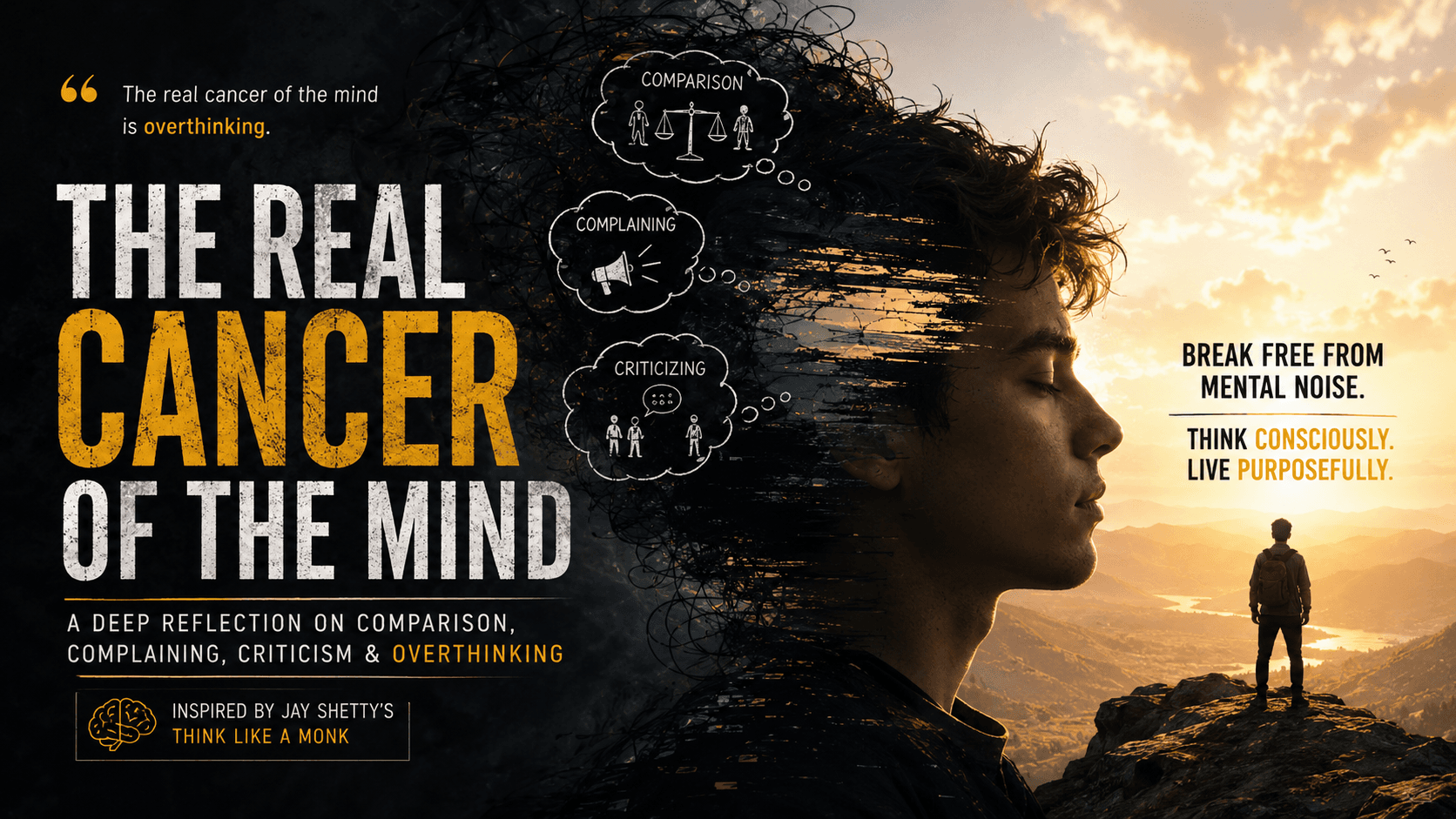
The Real Cancer of the Mind
8 min readThe Real Cancer of the Mind
A reflection inspired by Jay Shetty’s book Think Like a Monk and a deeper personal perspective on comparison, complaining, criticism, and overthinking.

Where This Thought Began
Recently, while reading the book Think Like a Monk by Jay Shetty, I came across an idea that deeply stayed in my mind. He described comparison, complaining, and criticizing as the “cancer of the mind.”
At first, I reflected on it seriously. But the more I thought about it, the more I realized that I could not completely agree.
From my perspective, the real cancer of the mind is overthinking.

Comparison Is Not Always Bad
People often say:
“Do not compare yourself with others.”
But can human beings really survive without comparison? I do not think so.
Real Life Example
Imagine buying a smartphone. Naturally, you compare battery life, camera quality, performance, price, and features before making a decision.
In that moment, comparison is not destroying your mind — it is helping you think wisely.

Even growth comes from comparison. Every person has someone they admire — an athlete, entrepreneur, artist, or leader. We look at their journey and feel inspired to improve ourselves.
Without comparison, there would be no ambition, no evolution, and no motivation to become better.

The problem is not comparison itself. The problem is unhealthy comparison.
Complaining Is Sometimes Necessary
Society often treats complaining as negativity. But silence is not always wisdom.
Example: Bad Roads
Suppose you are returning home from college and the road is full of potholes. What should you do?
Ignore it forever?
No. You file a complaint, write emails, and demand improvement.

Example: Relationships
If someone hurts you emotionally but does not realize their behavior is wrong, communication becomes necessary.
“The way you are behaving is hurting me. This needs to change.”

Complaining becomes harmful only when people complain without responsibility or action. But raising your voice against unfairness is not weakness — it is awareness.
Criticism Creates Independent Thinking
Many people only want agreement because agreement feels safe. The moment you disagree, conflict begins.
But disagreement is not always wrong.
Suppose your parents want you to choose a career that does not match your passion.
Should you blindly agree just to avoid conflict?

No. You should respectfully question it.
Criticism is important in families, friendships, governments, organizations, and society itself.
A society where nobody criticizes anything slowly becomes a society of blind followers.
Constructive criticism builds awareness.
So What Truly Destroys the Mind?
Comparison, complaining, and criticism are not naturally evil. They become dangerous only when they become toxic, unconscious, and excessive.
But overthinking slowly destroys a person from within. It creates fear before action, doubt before decisions, and confusion before clarity.
A person trapped in overthinking loses peace even in beautiful moments.

The mind does not become unhealthy because it thinks. It becomes unhealthy when thinking never stops.
“Conscious comparison creates growth. Unconscious comparison creates suffering.”
— Personal Reflection